

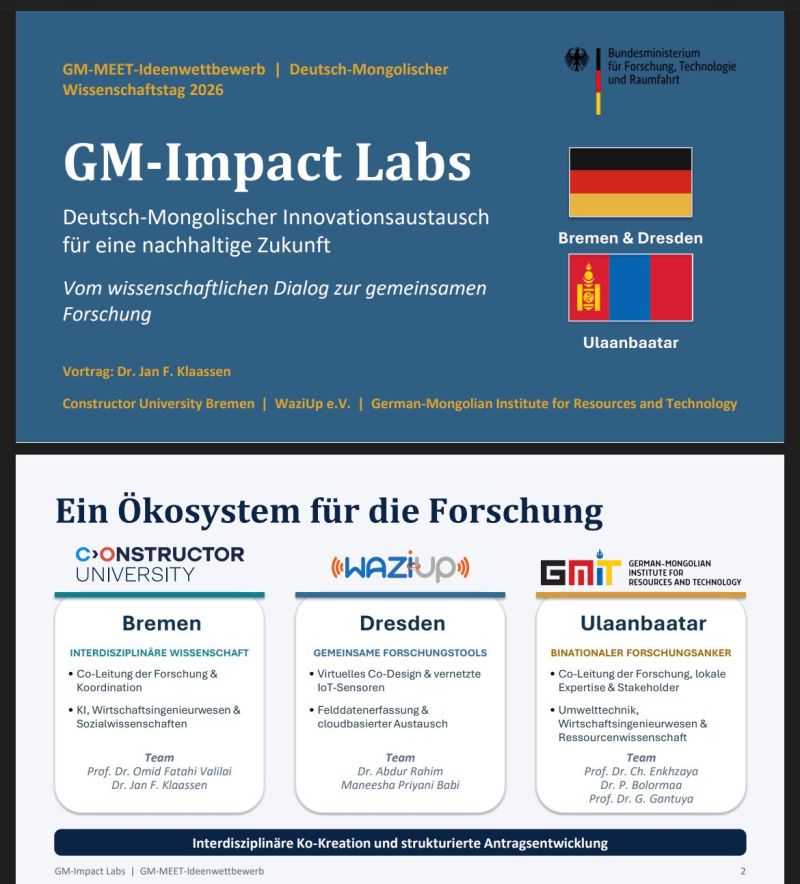
A new milestone has been reached in German-Mongolian research cooperation following the announcement of funding support for GM-Impact Labs: German-Mongolian Innovation Exchange for Sustainable Futures.
The project was presented during the German-Mongolian Science Day held in Berlin on 21 October 2026, organised by Germany’s Federal Ministry of Research, Technology and Space. Featured in the GM-MEET Competition of Ideas, the initiative was recognised for its contribution to strengthening bilateral scientific cooperation. Following the presentation, Mongolia’s Ministry of Education announced funding support, paving the way for the project’s implementation.
GM-Impact Labs brings together three partners: EITIE Research Lab at Constructor University in Bremen, Waziup e.V. in Dresden, and the German-Mongolian Institute for Resources and Technology (GMIT) in Ulaanbaatar.
The initiative aims to translate scientific exchange into joint research, innovative solutions and sustainable institutional partnerships. Its thematic focus includes climate resilience, sustainable raw-material management, circular engineering and AI-enabled decision support. Through connected sensing technologies and shared digital research environments, researchers will collaborate on data collection, scientific experimentation and evidence-based decision-making.
The programme will feature three interconnected events in Bremen, Ulaanbaatar and Bremen, complemented by continuous virtual collaboration. Researchers from both countries will identify shared scientific challenges, develop interdisciplinary research concepts and explore opportunities for international research funding.
A key priority is empowering early-career researchers, strengthening scientific capacity and connecting academic institutions with industry and society. Building on the international collaboration experience of the YouthTeamUp project, GM-Impact Labs aims to establish four to five bilateral research teams, encourage joint scientific publications, develop a shared research roadmap and prepare at least two follow-up project concepts.
For Waziup, this initiative provides an opportunity to contribute its expertise in IoT, connected sensing and digital collaboration to support interdisciplinary research and sustainable innovation.
We congratulate all partners and colleagues involved in this milestone and look forward to the start of the collaboration and the research opportunities it will create between Germany and Mongolia.